What Professional Concrete Cleaning Actually Includes
Start to finish, what happens on a driveway job and why each step is there. If you are comparing quotes, this is what you are comparing.
If you are getting quotes and one is noticeably cheaper, this is usually the page that explains why. Not because anyone is lying, but because “clean the driveway” describes several different amounts of work.
Here is the order the work should go in.
1. Inspection
Before anything gets wet, we walk it. What we are looking for:
- Age and finish of the concrete
- Cracking, spalling, or flaking that pressure would make worse
- What is actually staining it, since organic growth, clay, oil, and rust all get handled differently
- Where the water is going to run, and what is downhill of that
- Where the spigot is and whether it has decent flow
This is also when we tell you what is not going to come out. Doing it now instead of at the end is most of what keeps customers happy.
2. Clearing the area
Vehicles moved, planters and furniture off the slab, hoses and cords out of the way, and anything fragile relocated. It takes a few minutes and it prevents most of the ways a job goes sideways.
3. Protecting what is around it
Landscaping beside the work gets wet down. A saturated plant is far less able to take up anything that runs off it than a dry one, so pre-wetting is the actual protection, not a spray at the end.
Where beds are downhill of the work we plan the rinse path so runoff goes to the street rather than into the mulch.
4. Pretreatment, when it helps
Heavy organic growth gets a cleaning solution applied and given time to work.
This is the step that gets skipped on a cheap quote, and it is the one that changes how the result holds up. Pressure alone removes what you can see. A pretreatment kills the growth so it takes considerably longer to come back.
Not every job needs it. A lightly dirty two-year-old driveway usually does not. A five-year-old shaded slab absolutely does.
5. Surface cleaning the flat work
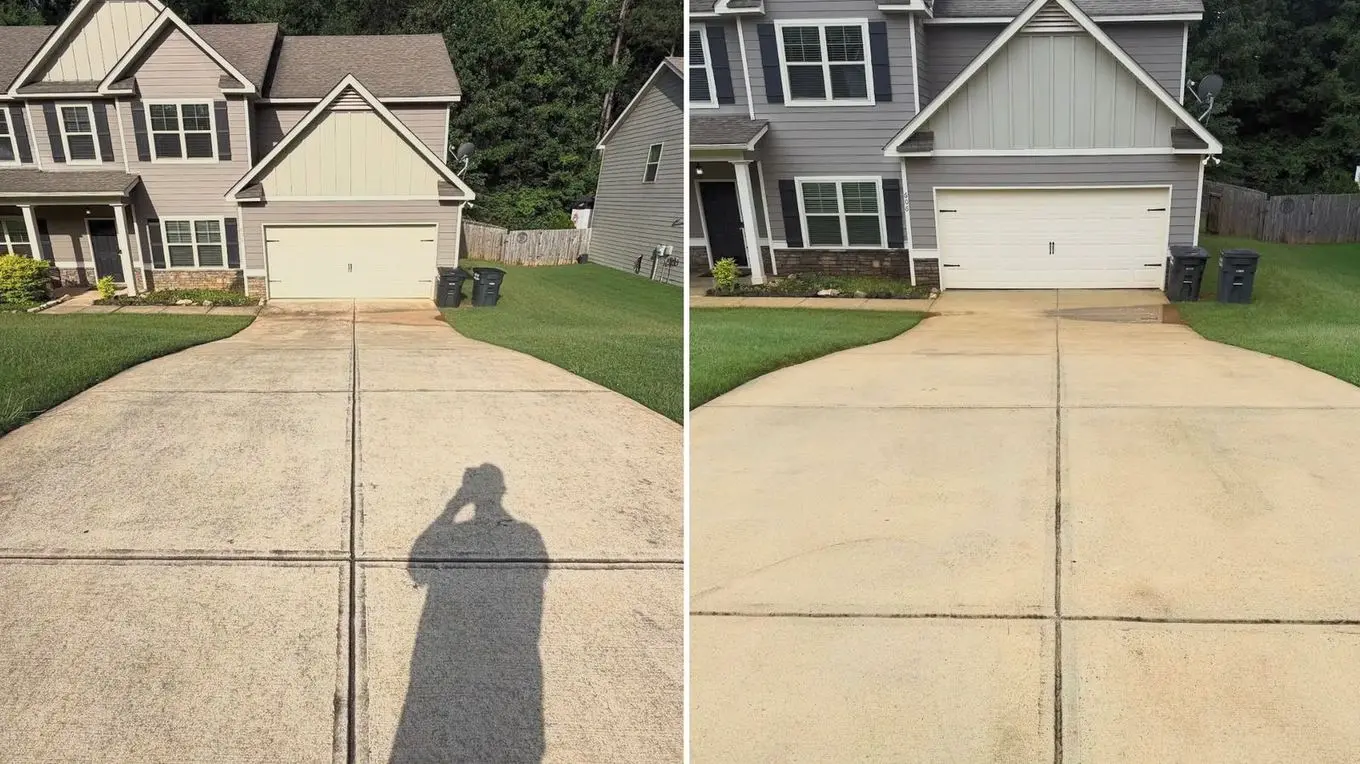
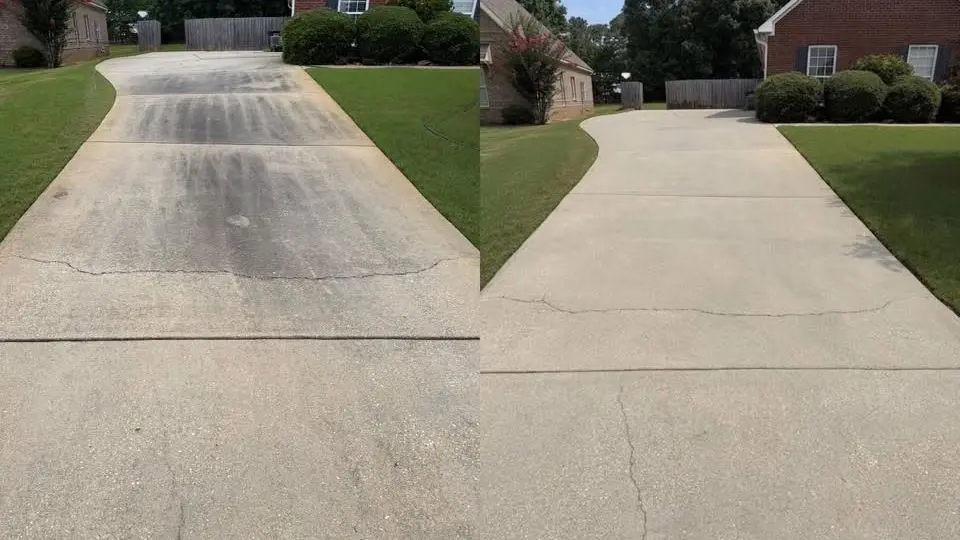
A rotating surface cleaner covers the open concrete in overlapping passes. Even pressure, even coverage, no stripes.
This is where most of the visible change happens, and it is the difference between a driveway that looks uniformly clean and one that looks like somebody waved a wand around on it.
6. Edge work by hand
A surface cleaner is round. Your driveway is not.
Edges against the grass, expansion joints, the seam where the slab meets the garage door, curbing, and any corner the machine cannot reach get worked with a wand at a controlled distance.
This is the slowest part of the job and it is completely obvious when it gets skipped. A slab cleaned in the middle with a dirty border around it looks worse than one that was never touched.
7. Full rinse
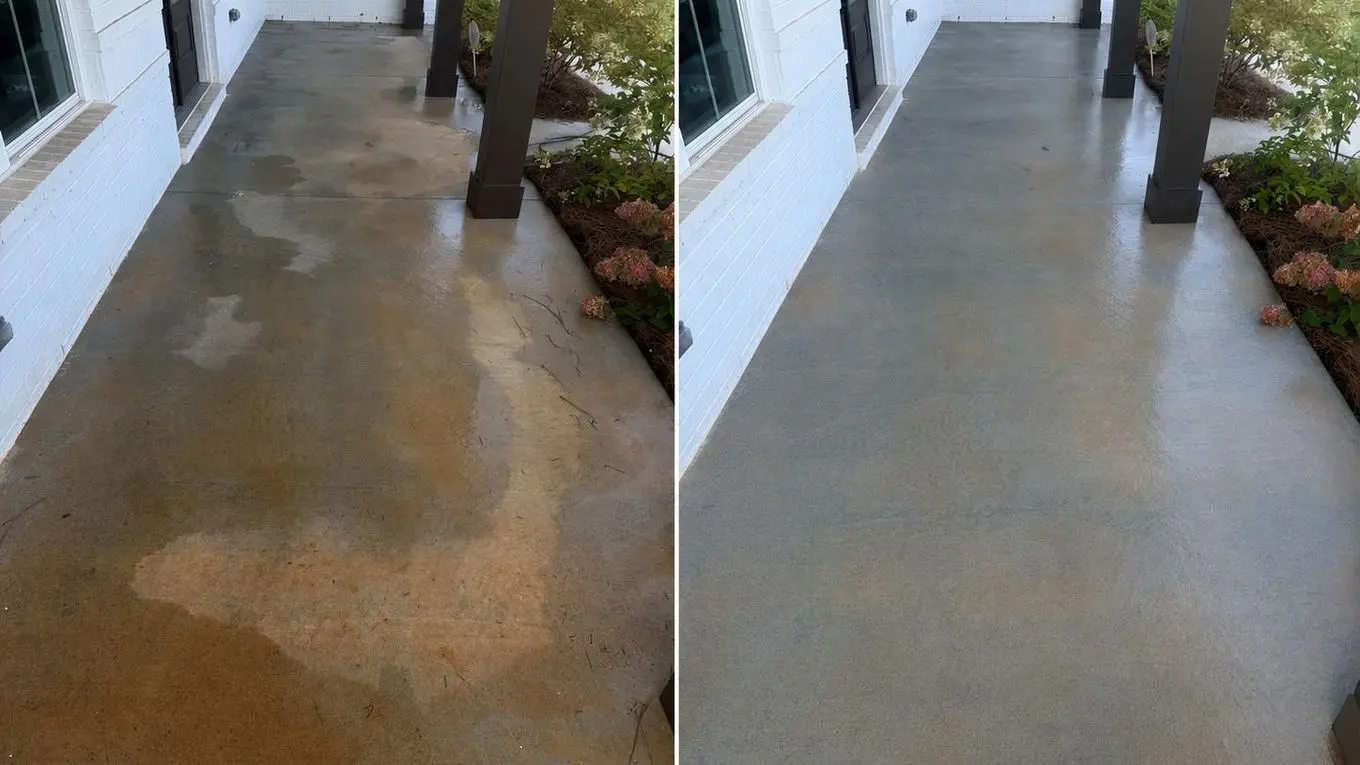
Everything gets rinsed down and the runoff carried off the concrete. Left alone, the slurry dries where it settles and leaves a tide line, which means the drive looks fine wet and streaked once it dries.
8. Post-treatment, when it is called for
On slabs with heavy growth or a lot of shade, a post-treatment can slow down how fast it comes back. Not every job needs one, so ask whether yours does.
9. Final walk
We look at it together before the trailer gets packed up. If a section needs another pass, that is the time to say it, not three days later.
What is not included
Sealing. That is separate work with its own timing requirements and its own cost, and concrete has to be completely dry through before anything goes on it.
Repair. Cracks, spalling, and settling are a mason’s job.
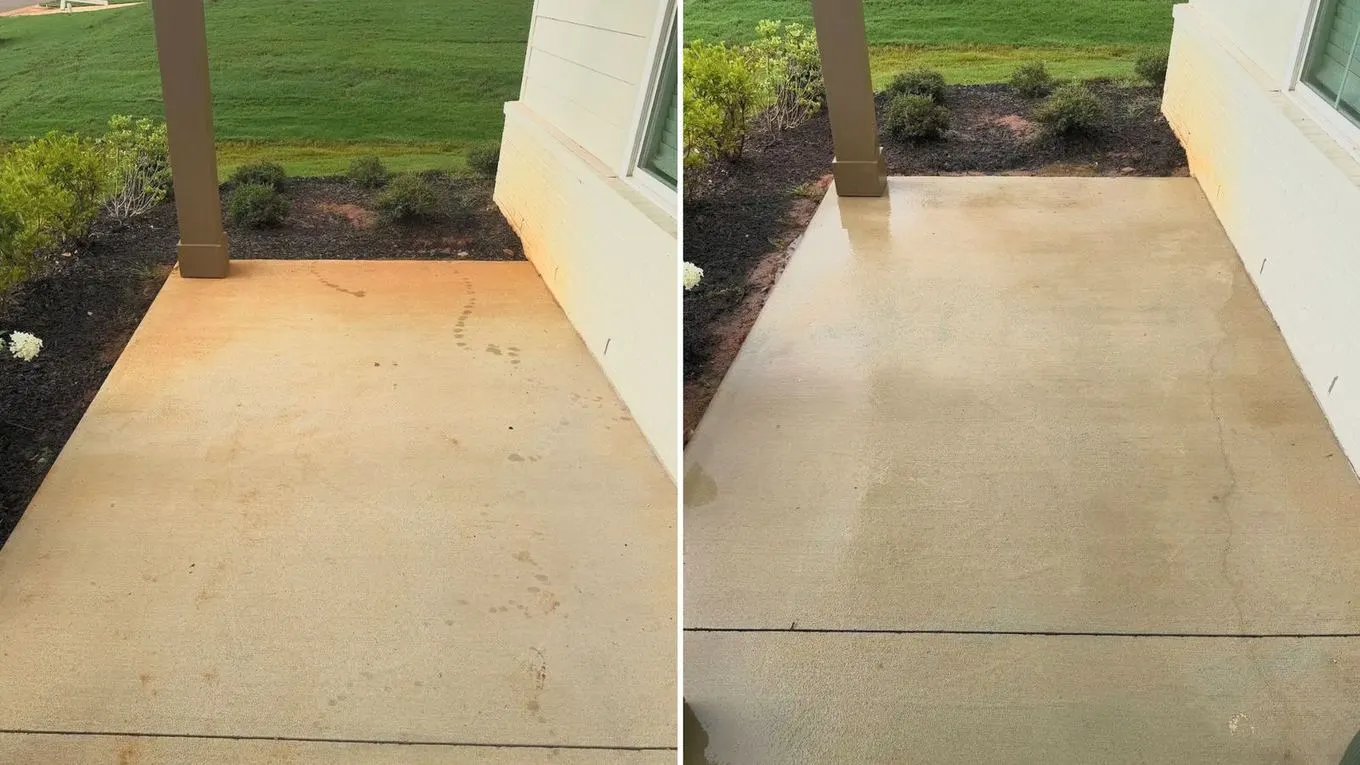
Miracles. Deep oil, old rust, permanent clay staining, and damage from the original pour are conditions of the concrete. We will lighten what can be lightened and we will tell you which category yours is in.
What to ask when comparing quotes
Ask whether pretreatment is included, whether edges are done by hand, and whether they are using a surface cleaner or a wand.
Those three answers explain almost every price difference you will see.
Have a surface you are not sure about?
Send a photo and tell us what you are dealing with. You will get a straight answer, including if the answer is that cleaning will not fix it.